Fri Jul 17 2026
How to Calm Anxiety at Night: Why Racing Thoughts Get Worse After Dark, and What Works
Racing thoughts keeping you up? Learn why anxiety gets worse at night and 7 techniques that calm it, plus when to see a Texas psychiatrist or therapist.
Clinically reviewed by Dr. Akinwande Akintola, MD
Dual board-certified · Johns Hopkins fellowship-trained
Medically reviewed by the Lyte Psychiatry care team · Updated July 2026 · 9-minute read
To calm anxiety at night, slow your body before you try to slow your mind. Breathe in for 4 counts and out for 8. Get out of bed if you've been awake more than 20 minutes. Write tomorrow's worries down on paper. Your thoughts race because your nervous system is still stuck in daytime alert mode, and that response is treatable.
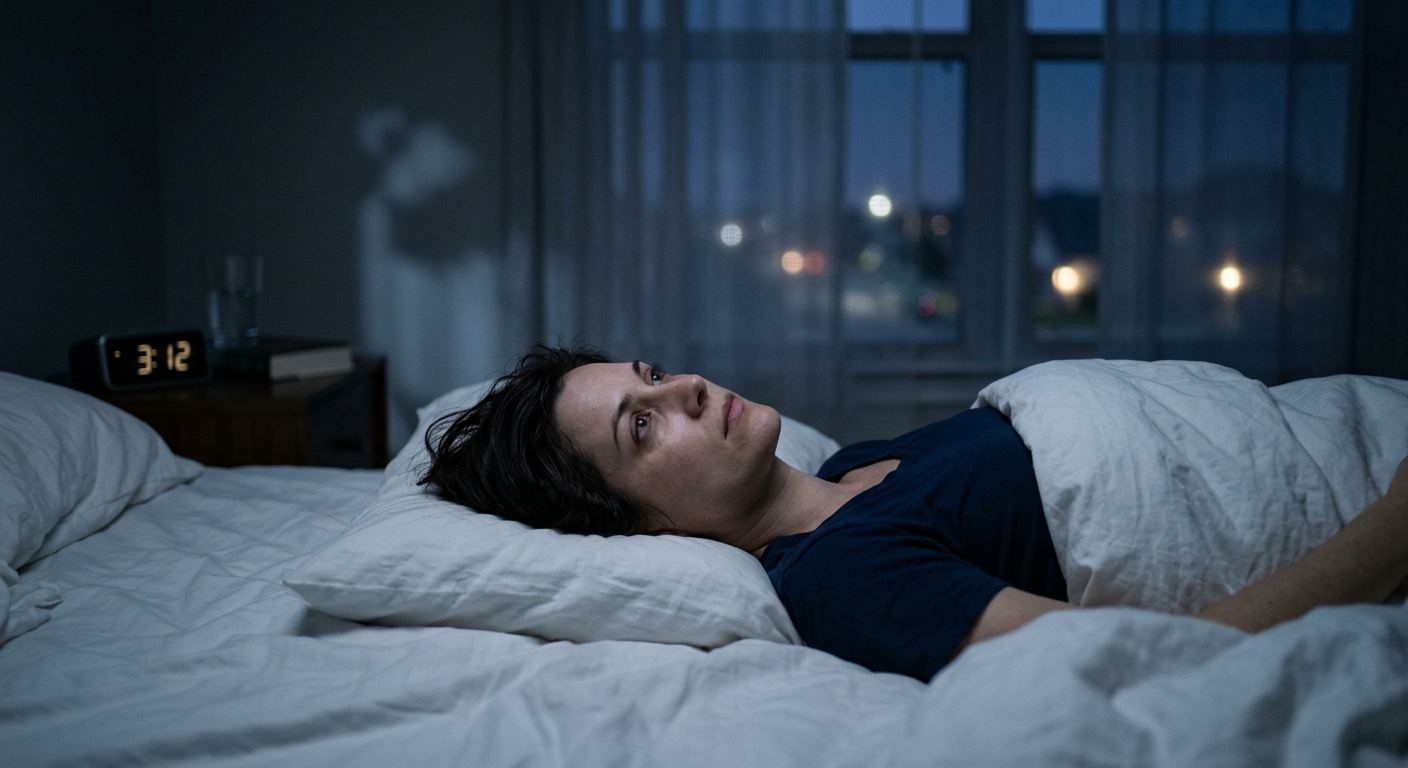
It's 1:40 a.m. You have to be up in five hours. Your body is exhausted, but your brain is replaying a conversation from Tuesday, drafting an email you can't send until morning, and doing the math on how tired you'll be tomorrow. Which makes falling asleep even harder. If that loop sounds familiar, it has a name, and it responds well to treatment.
This article covers what's happening in your brain at night, seven techniques you can use tonight, and how to tell when it's time to see a psychiatrist or therapist in Texas.
Why is my anxiety worse at night?
Anxiety feels worse at night for one main reason: the distractions are gone. During the day, work and conversations and screens soak up the mental bandwidth your worries would otherwise use. At night, in a dark quiet room, your brain finally has open space. An anxious brain fills open space with threat-scanning.
A few other things pile on:
- Your stress hormones don't clock out. Unresolved daytime stress keeps cortisol and adrenaline elevated into the evening, so your body stays in fight-or-flight when it should be winding down.
- Body sensations feel louder. In a silent room, a slightly fast heartbeat or shallow breathing becomes impossible to ignore. An anxious brain reads those sensations as danger, which triggers more adrenaline. The Sleep Foundation describes this loop as a core driver of nighttime anxiety.
- You start dreading bedtime itself. After a few bad nights, "what if I can't sleep again?" becomes its own anxious thought, and it shows up right on schedule.
Persistent night anxiety usually has a driver behind it: generalized anxiety disorder, panic disorder, OCD (intrusive thoughts often surge at bedtime), PTSD, caffeine or alcohol, certain medications, or medical conditions like sleep apnea and reflux that create panic-like body sensations. Treating the driver works better than fighting the symptom every night.
What causes racing thoughts at night?
Racing thoughts at night are usually your brain's open loops demanding attention. Psychologists call this the Zeigarnik effect: unfinished tasks stay mentally active until they're written down or resolved. Bedtime is the first quiet moment your brain gets all day, so it dumps the whole list at once. Deadlines. That awkward comment. The bill you forgot.
For some people, though, racing thoughts point to something more specific:
- Generalized anxiety: broad "what if" worry that jumps between topics
- OCD: the same intrusive thought or image on repeat, with a strong urge to neutralize it. This is different from ordinary worry and needs different treatment. Our OCD page explains ERP therapy.
- Nocturnal panic attacks: waking abruptly with a pounding heart, chest tightness, or a sense of doom. The Cleveland Clinic notes these attacks feel terrifying but aren't dangerous. They're also treatable.
The distinction matters. Racing thoughts caused by an untreated anxiety disorder won't fully resolve with sleep hygiene alone. Technique helps tonight; treatment fixes the pattern.
How do I calm anxiety at night? 7 techniques to try tonight
Work top to bottom. The first three calm your body. The rest retrain your mind.
- Do 4-8 breathing for two minutes. Inhale through your nose for 4 counts, exhale slowly through your mouth for 8. A long exhale activates the parasympathetic nervous system, your body's built-in brake, and slows your heart rate within a few minutes. Ten rounds.
- Try progressive muscle relaxation. Starting at your feet, tense each muscle group for 5 seconds, then release. Work up to your face. Anxiety lives in the body as much as the mind, and releasing physical tension tells your brain the threat has passed.
- Drop your bedroom to 65–68°F. Core body temperature has to fall for sleep to start. A cool dark room speeds that up. No small thing in a Texas summer.
- Get out of bed after 20 minutes awake. Sit somewhere dim and do something boring, like a paper book or light stretching, until you feel drowsy. Then go back. This is a core rule of CBT-I (cognitive behavioral therapy for insomnia). It works by breaking the learned link between your bed and lying awake anxious. Staying in bed and trying harder strengthens that link.
- Schedule a worry window. Earlier in the evening, not in bed, spend 15 minutes writing every worry on paper with one next step for each. When the thoughts show up at midnight you can tell your brain, honestly, "already handled." The Cleveland Clinic recommends offloading thoughts before bed rather than in it.
- Cut caffeine after noon and skip the nightcap. Caffeine has a 5–6 hour half-life, so a 3 p.m. coffee is still half-active at 9 p.m. Alcohol makes you drowsy, then fragments sleep and spikes anxiety around 3 a.m. as it wears off. People rarely connect the 3 a.m. dread to the drink.
- Put your phone in another room. Doomscrolling feeds your brain exactly the threat content it's already primed to fixate on, and screen light delays melatonin. If your phone is your alarm, a $10 alarm clock pays for itself the first week.
One thing not to do: check the clock. "If I fall asleep right now I'll get four hours" is an anxiety trigger, not information you can use.
Why do I wake up at 3 a.m. with anxiety?
Waking around 3 a.m. with a racing mind usually comes down to biology plus opportunity. Cortisol naturally starts rising in the second half of the night to prepare you for waking. If your baseline stress is high, that normal rise is enough to wake you fully, and once you're awake, an anxious brain gets to work. Alcohol, blood sugar dips, sleep apnea, and reflux can cause the same 2–4 a.m. wake-up.
If it happens once in a while, use the 20-minute rule above. If it's happening three or more nights a week for a month or more, that pattern has a name, sleep-maintenance insomnia, and it's one of the most treatable problems we see at our insomnia and sleep disorder service.
When should I see a doctor about nighttime anxiety?
See a psychiatrist or therapist if nighttime anxiety disrupts your sleep three or more nights a week for a month, affects your daytime mood or work, or makes you dread going to bed. Those are clinical thresholds, not personal failures. The earlier you treat it, the faster it resolves.
Other signs it's time:
- You wake up gasping, heart pounding, with a sense of doom (possible nocturnal panic attacks or sleep apnea, both worth evaluating)
- The same intrusive thought loops no matter what technique you try (possible OCD)
- You're using alcohol, cannabis, or bigger and bigger doses of sleep aids to knock yourself out
- Your daytime anxiety is climbing too
Not sure where you fall? Take our free 2-minute GAD-7 anxiety screening, the same validated scale (Spitzer et al.) clinicians use to measure anxiety severity.
What treatments work for anxiety-related insomnia?
CBT-I and anxiety-focused therapy are first-line, with medication as a partner when symptoms are moderate to severe.
- CBT-I (4–8 weekly sessions): retrains the brain-bed association. It's the American Academy of Sleep Medicine's only "strong" recommendation for chronic insomnia.
- CBT for anxiety (8–12 weekly sessions): targets the worry loops themselves, the upstream cause.
- ERP therapy (12–20 sessions): gold standard for OCD-driven intrusive thoughts at night.
- Medication management (initial response in 2–4 weeks): SSRIs/SNRIs lower baseline anxiety so nights calm down. Non-habit-forming sleep options exist too.
Most patients do best with a combination, which is why our psychiatrists and therapists share one chart and one plan. Weighing your options? See our plain-English comparison of therapy vs. medication.
The National Institute of Mental Health reports anxiety disorders affect roughly 1 in 5 U.S. adults each year, and they're among the most treatable conditions in psychiatry. The gap is access, not science: 170 of Texas's 254 counties have no practicing psychiatrist (Texas Psychiatry Access Report). That's why we treat nighttime anxiety by telehealth across all of Texas and New Mexico, with in-person care in DFW.
Getting help for night anxiety in Texas
If you've been white-knuckling your nights for months, here's what getting help looks like at Lyte Psychiatry: most new patients are seen within 1–2 business days, most insured patients pay a $0–$30 copay, and you can meet a board-certified psychiatrist or licensed therapist by video from anywhere in Texas. Dallas, Houston, Austin, San Antonio, El Paso, or a county with no psychiatrist at all. We track your progress with GAD-7 scores at every visit, so you can see your nights improving on paper instead of hoping they are.
Book an appointment or call (469) 733-0848. A real person answers.
FAQ: Anxiety at Night
How can I calm my anxiety at night fast?
Slow your exhale. Breathe in for 4 counts and out for 8 for ten rounds. The extended exhale activates your parasympathetic nervous system and lowers heart rate within minutes. Pair it with progressive muscle relaxation, tensing and releasing each muscle group from feet to face. Body first, mind second.
Why does my anxiety get worse at night?
Nighttime removes the distractions that soak up anxious energy during the day, magnifies body sensations like a fast heartbeat, and gives elevated stress hormones nowhere to go. After several bad nights, fear of sleeplessness itself becomes a trigger.
How do I stop racing thoughts at night?
Offload them before bed: spend 15 minutes earlier in the evening writing worries down with one next step each. In bed, redirect attention to your breath or a detailed mental scene. If the same intrusive thought loops nightly despite this, get screened for OCD or an anxiety disorder. Technique alone won't fix a clinical cause.
Is waking up at 3 a.m. with anxiety normal?
Once in a while, yes. Cortisol rises naturally in the early morning hours and can wake a stressed brain. Three or more nights a week for a month is sleep-maintenance insomnia, which is highly treatable with CBT-I and, when needed, medication.
What is a nocturnal panic attack?
A panic attack that wakes you from sleep: pounding heart, chest tightness, sweating, a sense of doom, usually peaking within 10 minutes. They're frightening but not physically dangerous, and they respond well to therapy and medication. Recurring episodes warrant an evaluation to rule out sleep apnea.
Can a psychiatrist help with anxiety and insomnia?
Yes. A psychiatrist can diagnose what's driving your nighttime anxiety, prescribe non-habit-forming medication when appropriate, and coordinate with a therapist for CBT or CBT-I. At Lyte Psychiatry, both are on one care team, and most Texas patients are seen by video within 1–2 business days.
Does Lyte Psychiatry treat sleep anxiety in my city?
We see patients in person in the Dallas–Fort Worth area and by secure video everywhere in Texas and New Mexico, including Houston, Austin, San Antonio, El Paso, Lubbock, and rural counties. We're in-network with BlueCross BlueShield, UnitedHealthcare, Cigna, Aetna, and more; most insured patients pay $0–$30 per visit.
If you're in crisis or having thoughts of harming yourself, call or text 988 (Suicide & Crisis Lifeline) or call 911. This article is for education and doesn't replace an evaluation by a licensed clinician.
Trusted Resources & Sources
NIMH — Anxiety Disorders
Diagnostic criteria and treatment options
ADAA — Anxiety Statistics
40M Americans affected — prevalence and impact data
APA — Anxiety Overview
Clinical summary from the American Psychological Association
Lyte Psychiatry articles are reviewed by board-certified psychiatrists and reference peer-reviewed research and federal health agency data.
Related Services
Lyte Psychiatry — Texas & New Mexico
Anxiety Treatment — Texas & New Mexico
Evidence-based care for generalized anxiety, social anxiety, panic disorder, and phobias.
Find Care Near You
Lyte Psychiatry serves patients across Texas and New Mexico — in-person in DFW and via telehealth statewide.
Don't see your city? View all Texas & New Mexico locations →
We accept BlueCross BlueShield, UnitedHealthcare, Cigna, Aetna, Ambetter, Humana, and Magellan Health. See full insurance & coverage guide →
Ready to get help?
Lyte Psychiatry serves patients across Texas and New Mexico — in-person in the DFW area and virtually statewide.
Book an Appointment →