Tue Nov 10 2026
Hybrid Psychiatric Care in Texas: When to Log On or Come In
A practical guide to mixing telehealth and office psychiatry visits in Texas, with a self-check, step-by-step plan, scripts and red flags.
Published by Lyte Psychiatry · Meet our care team
Written by the Lyte Psychiatry clinical team. Clinically reviewed by Ana G., LPC, and medically reviewed by Dr. Akinwande Akintola, MD, supervising physician. Last reviewed: November 7, 2026.
Hybrid psychiatric care means mixing telehealth visits and office visits over the course of treatment, instead of picking one format and sticking with it forever. Many people use video for routine medication check-ins and come in person when they need a physical check, a lab test, or a closer look at a change. You and your clinician decide together which format fits each visit.
This guide is for adults in Texas who already see a psychiatric clinician, or are about to start, and who wonder whether their next appointment should be on a screen or in a chair across the room. It is also for anyone who started with telehealth and has a quiet feeling that something needs a closer look, or who started in person and is tired of losing half a workday to the drive.
Key takeaways
- Hybrid psychiatric care is not a compromise. It lets the format of each visit follow what that visit needs to do.
- Routine follow-ups often work well by video. Physical checks, vital signs, lab work and some changes in symptoms are good reasons to ask about an office visit.
- Switching formats is a normal request. A short, clear message to your care team is usually enough to start the conversation.
- For a Texas telehealth visit, you must be physically located in Texas at the time of the visit. Rules vary by state, so ask before your visit if you will be traveling.
- Safety concerns come first. If you are in crisis, call or text 988, and call 911 for immediate danger.
What is hybrid psychiatric care?
Hybrid psychiatric care is a plan that uses both telehealth and in-person visits, chosen visit by visit based on what you need at that point in treatment. The federal government's telehealth site puts it simply: hybrid care uses both in-person visits and telehealth, and you and your provider decide together when to use each one, according to Telehealth.HHS.gov's page on hybrid care.
That last part matters. Hybrid care is a shared decision, not a rulebook. A video visit is not a lesser version of an office visit, and an office visit is not a punishment for something going wrong. They are two tools. Some jobs suit one better than the other.
If you have read our post on online vs in-person psychiatry in Texas, you already know how the two formats compare side by side. This post picks up where that one leaves off. Most people do not choose once. They move between formats as life, symptoms and treatment change. The question shifts from "Which one is right for me?" to "Which one is right for this visit?"
Why November is a good time to look at your visit schedule
Early November is a natural checkpoint, because the season changes how easy it is to get to an office and how you feel when you get there. Clocks fall back on the first Sunday of the month, so evenings get dark early. A 5:30 appointment that felt fine in September can mean a drive home in the dark through rush-hour traffic.
Then come the holidays. Thanksgiving travel, year-end deadlines, family visiting from out of town, kids' concerts that all land on the same week. Calendars fill up fast, and a mental health appointment is often the first thing people quietly cancel.
The season can also affect mood itself. The National Institute of Mental Health describes seasonal affective disorder as a type of depression with a recurring seasonal pattern, and notes that symptoms often start in the late fall or early winter, according to NIMH's page on seasonal affective disorder. Not everyone who feels heavier in November has that condition, but it is worth telling your clinician if you notice a pattern.
So this is a good month to ask two questions. Which upcoming visits could move to video so you keep them during a packed season? And is anything changing that makes an in-person visit worth the drive? The answers will be different next November, and that is the point. A hybrid plan can be revisited every season.
Which psychiatry visits often fit telehealth?
Routine follow-up visits, where you and your clinician mainly talk through how things are going, are often a good fit for telehealth. Telehealth.HHS.gov lists renewing prescriptions, reviewing lab or test results and answering health questions among the things virtual visits can be used for, and notes that behavioral health counseling can also be done remotely, according to its hybrid care page.
In psychiatry, that often includes visits like these. Treat this as a list of things to talk with your clinician about, not a set of rules.
- Routine medication check-ins when things are fairly stable. These visits usually focus on sleep, mood, daily function, side effects and whether the plan still makes sense. Our post on what happens at a medication management visit walks through what those conversations cover.
- Reviewing results after lab work has been done elsewhere, when there is nothing new to examine in person.
- Therapy sessions for many people, especially during busy weeks. Our post on getting the most from telehealth therapy has practical tips for making those sessions count.
When should you see a psychiatrist in person?
An office visit is worth asking about when your clinician needs to see, measure or test something that a camera cannot capture well. MedlinePlus, from the National Library of Medicine, notes that in some cases a provider may not be able to make the right diagnosis without examining you in person, and that a provider may need you to come in for a lab test, according to its telehealth overview.
Situations where many people and their clinicians choose an office visit include:
- A first evaluation, sometimes. Many first evaluations happen by video, and some people prefer to meet in person the first time. Ask which makes sense for you.
- When a physical exam, vital signs or lab work is needed. Blood pressure, weight, heart rate and some physical signs are easier to check in a room. Your clinician will tell you whether a given plan calls for that.
- A clear change in symptoms. If things are getting worse, or different in a way that is hard to put into words, being in the same room can help your clinician see the whole picture.
- A new side effect. Some side effects are easy to describe on video. Others, such as a new tremor, a rash, or feeling lightheaded when you stand, may be easier to assess in person.
- Safety concerns. If you or your clinician are worried about your safety, talk openly about which setting fits the next visit. If you are in danger right now, do not wait for any appointment. Call or text 988, or call 911.
- When home is not private. Sometimes the reason for an office visit has nothing to do with symptoms. If you cannot talk freely at home, a quiet office may be the only private room you have.
None of these is automatic. The key is to bring it up rather than guess.
Signs it may be time to switch formats
The clearest sign it is time to switch is that the current format is getting in the way of the visit doing its job. That can happen in either direction.
Signs to ask about moving from telehealth to an office visit
- You keep leaving video visits feeling that you did not get to say the important thing.
- Your connection drops so often that visits feel rushed or broken up.
- You notice a new physical symptom or side effect that is hard to show on camera.
- Your clinician has mentioned wanting to check vital signs or order lab work.
- Your symptoms have shifted, and you sense the plan may need a bigger rethink.
- You cannot find a private space at home, at work or in a parked car, and you are holding back because of it.
Signs to ask about moving from office visits to telehealth
- Things have been stable for a while, and most visits are a calm review of how the plan is working.
- The drive, parking or time off work is causing more stress than the visit relieves.
- You have skipped or rescheduled visits because getting to the office was too hard.
- Your season is about to get busy, such as the holidays or a work deadline, and you want to keep your visits rather than cancel them.
- Childcare, caregiving or a health issue makes leaving home difficult right now.
Switching is not permanent. Plenty of people move to video for a busy stretch and come back in person later, or do the reverse when something new comes up.
Self-check: is this a telehealth visit or an office visit?
Before your next appointment, a quick self-check can help you decide what to ask for. It does not replace your clinician's judgment. It just helps you start the conversation with something concrete.
Ask yourself these questions:
- Do I have a private place to talk? If not, an office visit may help. If yes, keep going.
- Has my clinician mentioned vital signs, a physical check or lab work? If yes, ask whether this visit should be in person.
- Is there a new side effect I would need to show, not just describe? If yes, mention it when you schedule.
- Have my symptoms changed in a way that worries me? If yes, tell the team when you book, and ask which format they recommend.
- Am I mostly stable, with a routine review coming up? If yes, telehealth may be a good fit.
- Will I be physically in Texas at the time of the visit? If not, ask before the visit what your options are.
- Is the main barrier time, distance or weather? If yes, and nothing above points to an office visit, ask about video.
If your answers point both ways, bring them to your care team and let them help you sort it out.
How do you set up a hybrid schedule, step by step?
You set up a hybrid schedule by agreeing with your clinician on which visits need to happen in person, then filling the rest with telehealth where it fits. Here is a simple way to do it.
- Start with your next three months. Look at your calendar and mark the weeks that are already busy, such as holidays, travel, school breaks and work crunch times.
- Ask your clinician which visits need to be in person. For example, a visit where vital signs, a physical check or lab work might be needed. Write those down first.
- Confirm format availability. Not every clinician or visit type is offered in both formats, so whether your clinician sees patients both by telehealth and in the office requires confirmation with the front desk.
- Check your insurance. Coverage for telehealth versus office visits varies by plan and requires confirmation. Ask your insurer and the clinic before you assume.
- Place telehealth visits in your busiest weeks. A video visit during your lunch break is better than a canceled office visit.
- Put office visits where the drive is easiest. Earlier in the day, lighter traffic weeks, or days you already plan to be nearby.
- Set up your telehealth basics once. Test your device, pick your private spot and keep your list of medications and questions in one place.
- Agree on what triggers a switch. Ask your clinician, "What would make you want to see me in person sooner?" Write their answer down.
- Review the plan each season. November, spring and back-to-school are good checkpoints. Life changes, and your schedule can too.
The National Institute of Mental Health suggests making a list of what you want to discuss and any questions or concerns before a visit, and telling your provider about all the medications you take, including over-the-counter products and supplements, according to NIMH's tips for talking with a health care provider about your mental health. That habit matters even more in hybrid care, because it keeps your visits connected no matter which format each one uses.
A hypothetical hybrid schedule over a few months
This is a hypothetical example, not a real patient or a recommended plan. It shows how a hybrid schedule can bend around ordinary life.
Hypothetical: Dana is a made-up 38-year-old who works in an office in Fort Worth and lives in a suburb farther out. She starts care in late summer for low mood and poor sleep.
- First visit: Dana chooses an in-person evaluation because she wants to meet her clinician face to face. Our post on what happens after a psychiatric evaluation explains what usually follows a visit like that.
- Early follow-ups: She does the next two follow-ups by video from a conference room at work with the door closed. They focus on sleep, mood, and how the plan is going.
- A change: In October she mentions a new side effect that is hard to describe. Her clinician suggests the next visit be in person. Dana books an early morning slot to beat traffic.
- November: With Thanksgiving travel and year-end work coming, Dana and her clinician agree to keep the next visit by video. She plans to stay in Texas for the holiday, so she schedules it for a day she will be at her sister's house in Austin, in a guest room with the door shut.
- Winter: Things settle. Dana keeps mostly video visits and agrees to come in person if her mood dips again or her clinician wants a physical check.
Each choice follows what that visit needs, plus what Dana's life looks like that month.
What to say when you want to switch
You can ask to switch formats with a short, direct message that says what you want and why. You do not need a perfect reason. Here are a few scripts you can adapt.
Asking to move a visit to telehealth
- "My next few weeks are packed with holiday travel and work. Could my next follow-up be a telehealth visit? I will be in Texas that day."
- "Things have been steady. Would it make sense to do my routine check-ins by video for a while?"
Asking to move a visit to the office
- "I have noticed a new side effect that is hard to describe on video. Can my next visit be in person?"
- "I do not have a private place to talk at home right now. Could I come into the office for my next appointment?"
- "My symptoms have changed, and I would feel better talking in person. What is the soonest office visit available?"
Asking how to decide
- "What would make you want to see me in person instead of by video?"
- "Are there any parts of my plan, like vital signs or lab work, that need an office visit?"
- "Is my clinician available for both formats, and does my insurance treat them differently?"
Can you do a Texas telehealth visit while traveling for the holidays?
Lyte Psychiatry offers telehealth visits to patients who are physically located in Texas at the time of the visit. That means a trip to see family in Houston or El Paso is fine for a Lyte telehealth visit, but a trip to see family in Oklahoma, Louisiana or anywhere else outside Texas is a different situation.
This is not a Lyte quirk. Telehealth.HHS.gov explains that health professionals must be licensed or legally permitted to practice in the state where the patient is located, and that the ability to deliver care across state lines varies based on state regulations, according to its guide to telehealth licensure. Rules vary by state, so do not assume what applies in one place applies everywhere.
If you will be traveling, the simplest approach is to ask before your visit. A few practical options to discuss with your care team:
- Move the visit to a day before you leave or after you get back.
- If you will be in another part of Texas, keep the telehealth visit and plan a private spot there.
- If you will be out of state for a while, ask your clinician what they recommend.
Expect to be asked where you are at the start of a telehealth visit. Telehealth.HHS.gov's behavioral health guidance tells clinicians to confirm the address where the patient is located at the time of the visit, according to its page on creating a telehealth emergency plan. That is partly about licensure and partly about safety, so your clinician knows where to send help if it is ever needed.
A quick note on cars: if you are parked somewhere in Texas, a telehealth visit from your car can work. Our short answer on doing your appointment from your car or office covers the details. Never take a visit while you are driving.
Privacy and tech basics for telehealth follow-ups
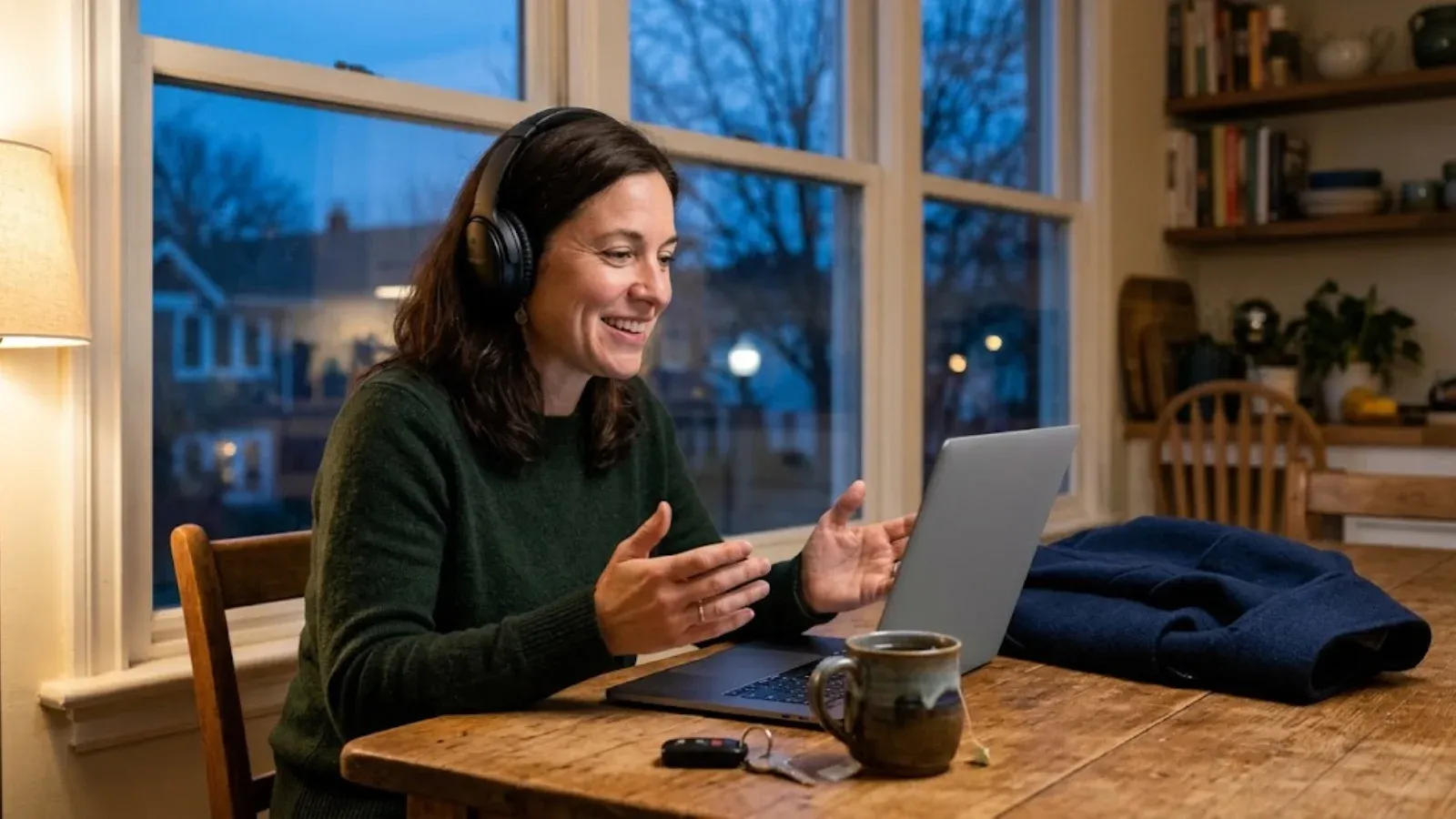
A good telehealth visit needs three things: a private space, a stable connection, and a device you have tested ahead of time. Telehealth.HHS.gov's guidance on protecting patient privacy suggests finding a private location, using headphones so others do not overhear, and avoiding public Wi-Fi while using password-protected devices to log on.
Some practical habits that make hybrid care easier:
- Pick your spot in advance. A bedroom with the door closed, a parked car, or a small office room. During the holidays, when the house is full, decide this before guests arrive.
- Use headphones. Even in a private room, they keep your side of the conversation quieter and help you hear clearly.
- Test your device the day before. Check the camera, microphone, battery and app updates.
- Skip public Wi-Fi. If your home connection is weak, your phone's own data connection may be better than a coffee shop network.
- Have a backup plan. Telehealth.HHS.gov encourages clinicians to talk with patients about what to do if the audio or video connection fails. Ask your care team what they do if a call drops.
- Name an emergency contact. The same guidance describes having a nearby family member, friend or neighbor who could help in a crisis. Your clinic may ask for one.
If privacy is on your mind more broadly, our post on whether to share your mental health story offers a privacy-first way to think about who knows what, which can help during a season full of family conversations.
What about insurance and controlled medications?
Both insurance and medication rules can affect how a hybrid plan works, and both need to be confirmed for your own situation rather than assumed.
Insurance. Coverage for telehealth versus office visits varies by plan and requires confirmation. Some plans treat the two formats the same, and others do not. Before you switch formats, ask your insurer and the clinic how each type of visit is covered. Our short answer on whether insurance covers online psychiatry visits has a few questions to ask.
Controlled medications. Federal rules on prescribing some controlled medications by telehealth have changed more than once, and your prescriber will explain what applies to you. Telehealth.HHS.gov keeps a page on prescribing controlled substances via telehealth that describes the current federal approach. If your treatment involves one of these medications, ask your prescriber whether any visits need to be in person, and check again if you hear the rules have changed.
This is also a good place to say plainly what hybrid care does not include. Lyte Psychiatry is an outpatient practice. It does not provide inpatient care, crisis or after-hours coverage, medically supervised detox, or intensive outpatient or partial hospitalization programs. If you need more support than outpatient visits can offer, your clinician can talk with you about next steps.
When to get help sooner: red flags
Some changes should not wait for your next scheduled visit, whether it is on video or in the office. If any of these happen, reach out sooner, and get emergency help when safety is at risk.
- Thoughts of suicide or of harming yourself or someone else. Call or text 988, or call 911 for immediate danger.
- A sudden, sharp worsening in mood, anxiety or sleep that does not ease after a few days.
- Feeling unable to keep yourself safe, or someone close to you is worried about your safety.
- A side effect that feels severe, frightening, or is getting worse quickly.
- Seeing or hearing things others do not, or feeling that your thoughts are not your own.
- Going several days with very little sleep while feeling unusually energized or driven.
- Being unable to eat, work, care for yourself or care for others the way you usually can.
- Using alcohol or other substances more to cope, especially if you are mixing them with medication.
For urgent but not emergency concerns, contact your care team and ask what they recommend. Since Lyte does not provide crisis or after-hours coverage, keep 988 and 911 in mind for anything that cannot wait. During the holidays, it helps to save these numbers in your phone and tell one trusted person where to find them.
Hybrid care in Texas: distance, DFW traffic and rural areas
Texas makes a strong case for hybrid care because distance and traffic shape how easy it is to get to any office. In-person visits are available at Lyte Psychiatry's clinic in Pantego, in the Dallas–Fort Worth area. For people living nearby, an office visit may be a short drive. For others across the metroplex, the same visit can mean a long stretch on a crowded highway, especially at rush hour or on a rainy evening.
DFW traffic is part of daily life, and it gets heavier around the holidays as shopping, events and travel add cars to the road. A practical approach many people use is to save office visits for times when the drive is lighter, such as mid-morning, and keep routine follow-ups on video.
Outside the metro area, the gap gets bigger. People in rural Texas, the Panhandle, West Texas or the Valley may live far from any psychiatric office. Telehealth can keep care regular, while an occasional office visit can be planned around a trip you are already making. Lyte Psychiatry offers telehealth visits to patients who are physically located in Texas at the time of the visit, so the format can follow you around the state.
Language access matters too. All Lyte Psychiatry services are available in Spanish. That holds for both formats, so you can choose telehealth or an office visit without giving up care in the language you are most comfortable with.
You can read more about how statewide video visits work on our telepsychiatry in Texas page.
Getting support in Texas
If you are thinking about hybrid psychiatric care, the next step is a conversation about what each of your upcoming visits needs to do. Lyte Psychiatry offers therapy, psychiatric evaluation and medication management in Texas. In-person visits are available at Lyte Psychiatry's clinic in Pantego, in the Dallas–Fort Worth area, and Lyte Psychiatry offers telehealth visits to patients who are physically located in Texas at the time of the visit.
Most new patients are seen within 1–2 business days. Weekend appointments are limited. Availability, insurance and clinician fit require confirmation, including whether a given clinician sees patients in both formats. All Lyte Psychiatry services are available in Spanish.
If you are already in care, bring the self-check above to your next visit and ask your clinician how they would like to split future appointments. If you are starting fresh, our medication management page explains how ongoing follow-up works, and you can contact Lyte Psychiatry to ask about telehealth and office visits before you book.
The holidays will fill your calendar either way. A hybrid plan helps make sure your mental health care stays on it.
If you are in a mental-health crisis in the United States, call or text 988. Call 911 for immediate danger.
Educational information, not a diagnosis or individual treatment plan.
Common Questions
Frequently Asked Questions
What is hybrid psychiatric care?
Hybrid psychiatric care is a treatment plan that mixes telehealth visits and in-person office visits over time. Instead of choosing one format for good, you and your clinician decide visit by visit which one fits. Many people use video for routine follow-ups and come into the office when a physical check, lab work or a closer look at a change is needed.
When should I switch from telehealth to an in-person psychiatry visit?
Ask about an office visit when your clinician needs to see, measure or test something a camera cannot capture well. Common reasons include checking vital signs, lab work, a new side effect that is hard to describe, a clear change in symptoms, or not having a private place to talk at home. Your clinician makes the final call with you.
Can routine medication follow-ups be done by telehealth?
Often, yes. Routine medication check-ins that focus on sleep, mood, daily function and side effects are frequently done by video when things are fairly stable. Your prescriber decides whether a given visit can be virtual, and some plans call for periodic office visits. Ask at your next appointment which follow-ups suit telehealth and which should happen in person.
Can I keep my Texas telehealth appointment while traveling for Thanksgiving?
Only if you will be physically in Texas at the time of the visit. Lyte Psychiatry offers telehealth visits to patients who are physically located in Texas at the time of the visit. Rules vary by state, so if you will be traveling, ask your care team before the visit whether to reschedule or move it to a day you are home.
How do I ask my psychiatrist to switch to video or office visits?
Send a short message that says what you want and why. For example: "My next few weeks are packed. Could my next follow-up be by video? I will be in Texas that day." Or: "I noticed a new side effect. Can my next visit be in person?" Clinicians handle these requests often, so a clear, simple ask is enough.
Does insurance cover telehealth and in-person psychiatry visits the same way?
Not always. Coverage for telehealth versus office visits varies by plan and requires confirmation. Some plans treat both formats the same, while others handle them differently. Before you switch formats, call your insurer and ask the clinic how each visit type is covered, so a change in format does not lead to an unexpected bill or a denied claim later on.
Can my psychiatric clinician see me both online and in the office?
It depends. Not every clinician or visit type is offered in both formats, so availability requires confirmation with the clinic. When you book, ask whether your clinician offers telehealth and office visits, which visit types are available in each format, and how far ahead you need to schedule an in-person slot. Insurance and clinician fit also require confirmation.
Are controlled medications handled differently in telehealth psychiatry?
They can be. Federal rules on prescribing some controlled medications by telehealth have changed more than once, and your prescriber will explain what applies to you. If your treatment involves one of these medications, ask whether any visits need to be in person, and check again if you hear the rules have changed. Telehealth.HHS.gov tracks the current federal approach.
What should I do if I feel worse between scheduled visits?
Reach out to your care team rather than waiting for your next appointment, whatever its format. Describe what changed and when it started. If you have thoughts of harming yourself or others, or feel unable to stay safe, call or text 988, or call 911 for immediate danger. Lyte Psychiatry does not provide crisis or after-hours coverage.
Insurance & Cost Questions?
Coverage and costs depend on your specific plan, clinician, visit type and deductible. Confirm network status and expected costs before booking.
Further Reading
NIMH — Mental Health Medications
Comprehensive overview of psychiatric medications
FDA — Drug Safety Communications
Official FDA safety information for mental health medications
SAMHSA — Medication-Assisted Treatment
Evidence base for pharmacological treatment approaches
These topic resources supplement the references linked within the article.
Your next steps for medication management
Choose the question that fits where you are now. Self-help tools support reflection and preparation; they do not diagnose a condition or replace care.
Who could I meet?
- Toyin Awe, PMHNP-BCPsychiatric Mental Health Nurse Practitioner
- Dr. Akinwande Akintola, MDSupervisory Psychiatrist & Medical Director
The clinic confirms clinician fit, availability and insurance participation before scheduling.
Meet all Lyte clinicians · Understand provider roles
What will it cost, and how do I book?
Check insurance and benefits · View self-pay prices
Request an appointmentLyte Psychiatry — Texas
Medication Management — Texas
Expert psychiatric prescribing and ongoing medication monitoring by board-certified providers.
Find Care Near You
Lyte Psychiatry serves patients across Texas — in-person in DFW and via telehealth statewide.
Don't see your city? View all Texas locations →
Questions about cost? View insurance and payment information